
Knowledge: articles on how to talk to people aged 50+ in Poland. Figures with sources are in the Data section.
Purchasing power of the 50+ generation in Poland: where PLN 30 billion a month comes from
On stage at I Love Marketing, a Polish marketing conference, I asked the audience to put a price on me from head to toe. They named a figure, lower than what I was actually wearing that day. The same calculation can be done for the whole 50+ group, and then it stops being an anecdote.

Monthly consumer spending by Poles over 50 is about PLN 30 billion. The figure is Silver TV's own calculation based on two Statistics Poland (GUS) figures for 2025: 14.9 million people multiplied by PLN 2,015 of average monthly spending per person. The calculation has two components and anyone can check it. What follows from it for media planning is the harder part.
Where does PLN 30 billion a month come from?
From two GUS figures for the same year. At the end of 2025 there were 14.9 million Poles over fifty. Average monthly spending per person in a household was PLN 2,015 in 2025. The product is PLN 29.99 billion, or about PLN 30 billion a month.
On the I Love Marketing stage I gave a lower figure, PLN 17.8 billion: 11.5 million people times PLN 1,546, after subtracting about 3 million of the oldest. When we were preparing this text, we could not find the PLN 1,546 figure in the GUS series for any year, and we cannot back the subtraction of the oldest with a source. That is why we are calculating from scratch, on the whole group and on data anyone can check with the publisher.
I showed this calculation from the stage, on a slide, to a room of marketers who had heard a moment earlier that the only target that counts now ends before fifty. The calculation was an answer to that sentence, not to a question from the floor.
You want that kind of cash? Then talk to us, show yourselves to us.
Poles over 50
spending per person per month, GUS 2025
spending per month
Is PLN 2,015 per person a lot?
It is an average for the whole population, not a measurement made separately for the 50+ group. For older people, GUS shows both sides of that average: in households with at least one person over sixty, spending per person was PLN 1,751 in 2024, and in households made up only of people aged 60+ it was as much as PLN 2,334.
Caution in choosing the figure has its price. The same average treats a fifty-year-old woman at the peak of her career and an eighty-year-old man on the minimum pension in the same way. So the calculation shows an order of magnitude, not a budget you can write into a specific campaign.
What does this group pay for?
The same things as everyone else. The most common objection I hear from brands goes like this: we have no products for this group, so we have nothing to sell them. It assumes that people over fifty shop in a separate product range.
We don't only use Corega and grey-hair restorers. We use everything, like normal people.
Clothes, cosmetics, hairdressing and beauty services, electronics, trips, cars. The same categories, the same shops. A shampoo does not have to be for 50+, it has to be good, and a lipstick does not have to be for 50+, it has to be a good colour. Why age alone is not enough as a criterion, I take apart in the piece on what silver marketing is.
Why is this money not visible in the 50+ group?
Because a large part of it is spent elsewhere. The money leaves a fifty-year-old's account, and the consumption shows up in a younger group: a wedding, a pram for a grandchild, help with a flat, a trip for adult children. A shopping panel assigns the purchase to whoever uses the product, not to whoever paid for it.
The second reason is earnings. The wealthiest generation in Poland today is aged 50–65, because that is where people with the longest work history, and the highest salaries that come with it, end up. This is a claim from the talk, not a GUS measurement, and that is how we present it. Demographics broken down by segment are set out in the overview Poles aged 50+ in numbers.
Does anyone outside Silver TV confirm this?
Yes, for a narrower age group. In September 2026 YouGov reported that consumers over 60 account for about 25 percent of FMCG spending in Poland, which means one in four złoty spent on FMCG. The average spend per shopping trip in this group is about PLN 46. Baskets are smaller, but there are more trips.
These are data on the 60+ group, so they do not carry over to the whole 50+ group or to the calculation above. The publisher did not give the sample size or the fieldwork period, and I say so together with the figure. A third source looks at the same thing from another angle: according to California Management Review, the 54+ group accounts for more than 40 percent of consumer spending.
What does this figure mean for a campaign?
The objection I hear after every calculation like this is the truest of all: for years, reaching this group was expensive and scattered. There is no single place where 14.9 million people sit.
Money is only half of it, because you also need to know whether it can be spent with you. Two figures say it can. 79 percent of people in this group shop online, so a campaign does not have to stop at building awareness. 69 percent say they are ready to switch to a better brand, so the places in the basket are not handed out for good. With a 39.9 percent share of the population, it is hard to call this a niche.
What to do with this in practice, I have collected in the piece on five myths about the 50+ consumer, because each of them ends in a different media decision.
PLN 30 billion is our own calculation based on GUS data, not a market measurement. The PLN 2,015 average applies to the whole population, not to the 50+ group separately, so the result shows an order of magnitude, not a budget. The PLN 17.8 billion figure from the talk at I Love Marketing 2025 was based on an average we did not find at GUS. Since September 2026, PLN 30 billion is the figure used in our materials.
Sources
Beata Borucka, talk at the I Love Marketing 2025 conference (the original purchasing power calculation of PLN 17.8 billion, the claim about the wealthiest generation aged 50–65, 79 percent shopping online, 69 percent ready to switch brands)
Statistics Poland (GUS), „Sytuacja gospodarstw domowych w 2025 r. w świetle wyników badania budżetów gospodarstw domowych” [“The situation of households in 2025 in the light of the Household Budget Survey results”], 27 May 2026 (PLN 2,015 of average monthly spending per person) - stat.gov.pl
Statistics Poland (GUS), „Sytuacja osób starszych w Polsce w 2024 r.” [“The situation of older people in Poland in 2024”], 18 December 2025 (spending per person in older people's households) - stat.gov.pl
Statistics Poland (GUS), „Ludność. Stan i struktura oraz ruch naturalny w przekroju terytorialnym w 2025 r. Stan w dniu 31 grudnia” [“Population. Size and structure and vital statistics by territorial division in 2025. As of 31 December”], table 1 (14.9 million people aged 50+, a 39.9 percent share; the age groups were summed by Silver TV) - stat.gov.pl
YouGov, „Silver - generacja przyszłości” [“Silver – the generation of the future”], published 14 September 2026 (share of the 60+ group in FMCG spending, average spend per shopping trip) - yougov.com
California Management Review 68(2)/2026 (share of the 54+ group in consumer spending)
The 79 percent and 69 percent values come from a conference talk that cited consumer research without naming the publisher. We give them with this caveat and are looking for the original publications. The YouGov study does not disclose the sample size or the fieldwork period.
Quick answers
What is the purchasing power of the 50+ group in Poland?
About PLN 30 billion a month. This is Silver TV's calculation based on GUS data for 2025: 14.9 million people multiplied by PLN 2,015 of average monthly spending per person.
Why was PLN 17.8 billion given earlier?
That was the result of the calculation shown at I Love Marketing 2025: 11.5 million people times PLN 1,546. The PLN 1,546 figure is not in the GUS series, and the subtraction of the oldest part of the group cannot be backed by a source, so we recalculated the result on the whole group and on GUS data for 2025.
Which age group is the wealthiest in Poland?
According to a claim made in the talk at I Love Marketing 2025, it is the generation aged 50–65, because of the longest work history and the highest salaries. This is a claim from the talk, not a GUS measurement.
Do external sources confirm the purchasing power of the 50+ group?
Partly. In September 2026 YouGov reported that consumers aged 60+ account for about 25 percent of FMCG spending in Poland. This concerns a narrower age group than the whole 50+ group.
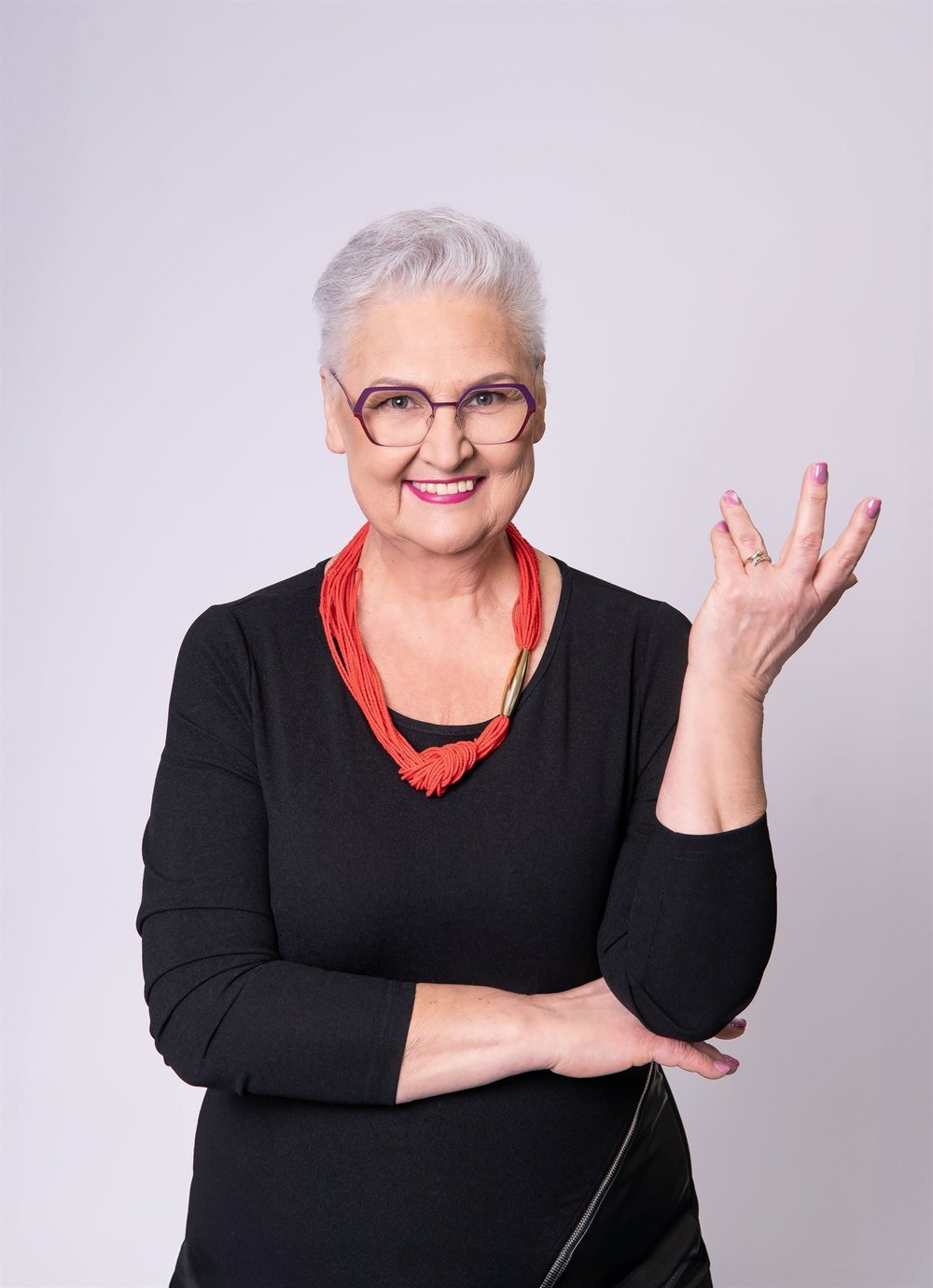
CEO of Silver TV, known online as Mądra Babcia (“Wise Grandma”). Speaker at I Love Marketing, a Polish marketing conference, where she talks about communicating with the 50+ generation.
silver-marketing.pl is published by Silver TV — internet television for viewers aged 50+ in Poland, with its own formats and a community on four platforms.
Formats for brands